Equal Vision
Dr. Rajesh Takyar
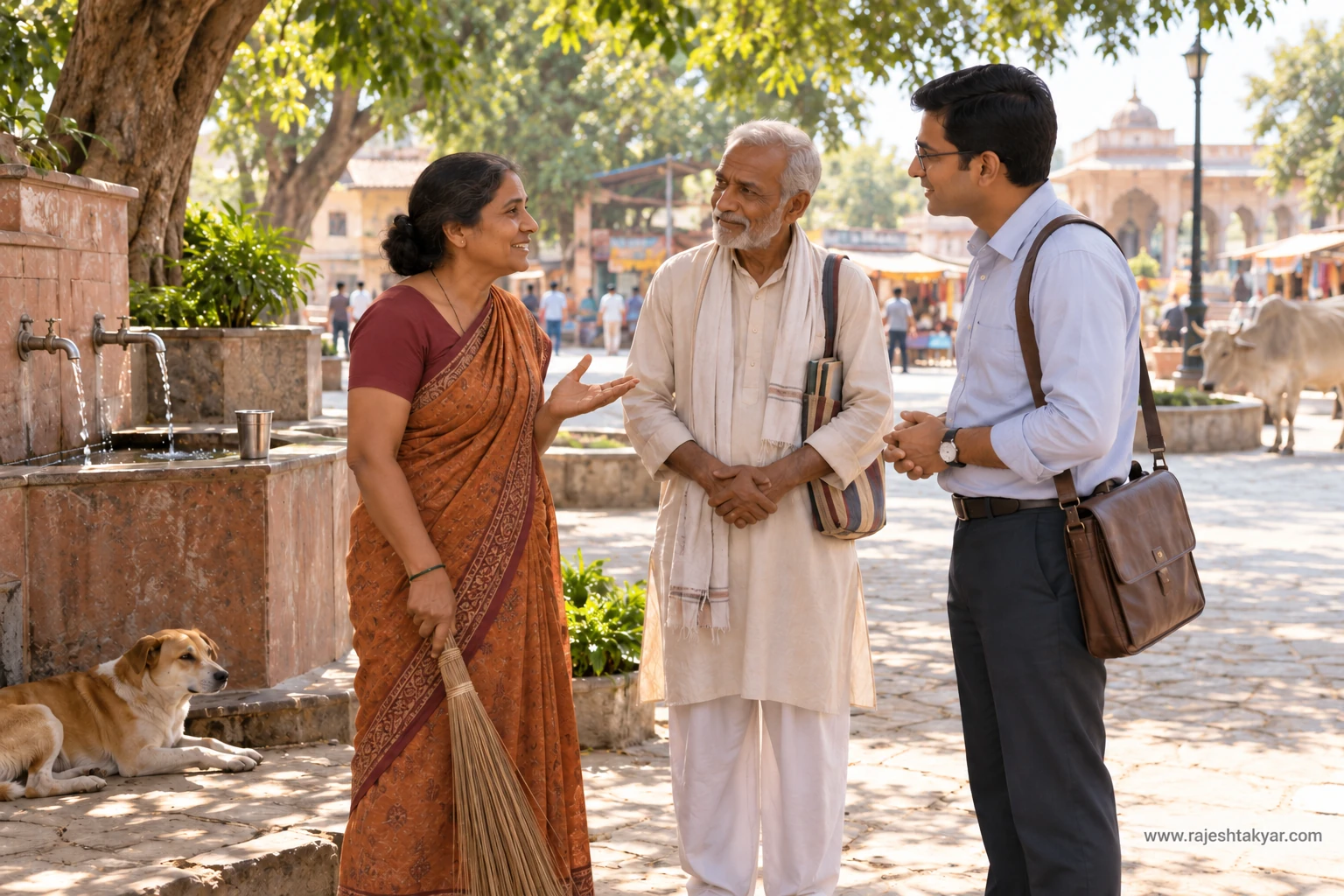
We often listen to someone after learning their position, offer respect according to their income, and keep our distance after hearing about their background. Equal vision places a direct question before this habit: can a person’s dignity be diminished by our assessment of them? This explanation from Part Five turns our attention towards spiritual equality amid outward differences, and towards justice in our conduct.
One Spiritual Foundation in Different Forms
The truly wise look equally upon a Brahmin endowed with learning and humility, a cow, an elephant, a dog and a Chandala. This is what Shri Krishna says in the eighteenth verse of Part Five of the Shrimad Bhagavad Gita. A truly wise person cannot merely acquire knowledge and continue to be called knowledgeable; they must always maintain an equal vision, whoever stands before them. The cow, elephant, dog and Chandala are examples here. A person must hold this vision towards everyone. Ordinary people keep discriminating on the basis of caste, appearance, colour, position and circumstances. The truly wise, however, see the same soul and a part of the Supreme in everyone. Whether Brahmin or Chandala, animal or human, the soul is the same in all. The vision of the wise therefore rests on equality, beyond discrimination. This is the lofty ideal of wisdom. The mark of a true pandit, or wise person, is to look upon every living being with equal vision.
Lord Krishna’s meaning is that equal vision does not imply that everyone’s outward qualities or actions are identical. The conduct of a Brahmin and a Chandala differs; the nature of a cow differs from that of an elephant. Yet the wise do not focus on these outward differences; they see the soul. The soul is alike in all: pure, eternal and indestructible. Ordinary people discriminate on the basis of body, caste, language, religion or conduct. This is a consequence of ignorance. As long as someone regards the body itself as ‘I’, they will continue to discriminate. When they understand that the real ‘I’ is the soul, they begin to see that same soul in everyone.
Equal vision has a profound significance and brings balance to life. It means looking upon all beings, circumstances and things with an even disposition, without partiality, attachment or hatred. When a person understands that every soul is a part of the same Supreme Being, they no longer discriminate by treating people as high or low, great or small, rich or poor, or by judging caste, religion, colour or appearance. In truth, the practice of equal vision is the foundation on which society’s genuine unity and peace rest. Looking at life, we find differences everywhere: one person has greater wealth, another more knowledge, another strength, and another a deeper capacity for compassion. Despite these differences, the foundation of everyone’s existence is the same. Waves rise in the ocean in different shapes and at different speeds, yet all merge into the same water. In the same way, all of us human beings, who have emerged from the one Brahman, must return to that same Brahman. Equal vision teaches us neither to envy another’s success nor to respond to another’s suffering with disgust or distance. This outlook gives rise to balance and compassion in life.
The Daily Practice of Respect
When equal vision develops within someone, they become filled with compassion and empathy towards others. For example, on meeting a poor person, they help out of compassion without regarding that person as inferior. Similarly, when they meet someone wealthy, they feel no envy; they regard that person too as a fellow being who shares the same soul, without entering into rivalry. Equal vision does not mean denying differences. It means accepting differences while maintaining the same regard for everyone. This attitude keeps us away from anger, greed, ego and hatred. When we begin to regard every person as being like ourselves, our relationships improve and inner peace also takes root in our lives.
The greatest importance of equal vision is that it makes a person just. When our outlook is free from partiality, our decisions too become impartial. This quality distinguishes a good friend, leader, teacher or family member. If everyone in society were to practise equal vision, disputes, quarrels, wars and violence would cease on their own, because their root causes are partiality, greed and discrimination. Equal vision teaches us that all religions are paths towards truth, all beings have the right to live, and the same consciousness exists in all.
Here in the Shrimad Bhagavad Gita, Lord Shri Krishna explains through examples that a wise person looks equally upon a Brahmin, a cow, an elephant, a dog and even a Chandala. Bodies may differ, but the nature of the soul is the same in all. When this truth becomes part of our experience, no reason for ego remains, and we become filled with love and respect for everyone. This state leads towards liberation. Equal vision is greatly needed in our own lives as well. If parents look upon all their children equally, there will be no discord at home. If teachers regard all students with the same goodwill, the learning environment will become natural and joyful. If society treats all its groups as equal, evils such as caste discrimination and notions of high and low will disappear. Even at work, if employers and employees maintain mutual respect and a sense of equality, the working environment will become pleasant and productive.
Equality and Justice Go Together
In today’s world, where competition, discrimination and inequality are discussed everywhere, adopting equal vision is even more necessary. It supports our personal progress and also guides society towards harmony and peace. When every person understands that all souls are equal and that the same divinity dwells within everyone, true fellowship and peace will be established in the world. Equal vision is more than an idea or an ideal; it is an art of living that makes us human in the fullest sense. It brings justice, compassion and love into our conduct, thoughts, relationships and decisions. Its importance lies in leading us towards self-knowledge and giving us the vision through which we can regard everyone equally. This attitude raises a person above distinctions of small and great, high and low, rich and poor, and takes them towards true spiritual joy and peace.
Equal vision keeps a person free from ego and hatred. When someone sees everyone equally, feelings of envy, hatred, pride and contempt fade away. The mind then becomes pure and remains filled with genuine love and compassion. This state gives stability and peace to the practitioner of karma yoga. Advaita teaches that the soul and the Supreme are one, and that all living beings are parts of that same truth. When a person begins to perceive this truth, Brahmin and Chandala, cow and dog, all become equal in their eyes. This is samadarshita, equal vision. It is this highest knowledge that Lord Krishna expresses here.
Even today, some people in society discriminate on the basis of caste, religion, colour and position. This verse teaches them that a truly wise person does not do so. The wise regard everyone as sharing the same soul. If one person is rich and another poor, one educated and another uneducated, an ordinary outlook grants them different degrees of respect. That is wrong. The wise know that the soul is the same in everyone; for them, respect means extending it equally to all. True knowledge removes discrimination. Brahmin, cow, elephant, dog, Chandala and others all share the same soul. Knowing this truth spoken by the Lord, the wise look upon everyone with equal vision. This equal vision is the fundamental basis of yoga and liberation.
A Day with Equal Vision
Tomorrow, pay attention to how you behave towards the people you meet. Does your manner of speaking change in the presence of an influential person? Do you impatiently interrupt someone who serves you? Is a family member’s opinion given less importance because of their age or income? The practice of equal vision can begin in these small encounters.
It is not necessary to give everyone the same work or the same responsibility. Ability, circumstances and roles will still need consideration. But everyone should receive respect, the opportunity to be heard and fair treatment. Understanding this distinction is useful. A sense of spiritual equality enters our lives when we can recognise another’s needs and choose appropriate conduct over our own convenience. Such a vision makes our relationships more humane.
Book reference: Shrimad Bhagavad Gita — Karm Kya Hai


Comments
Post a Comment