Balance in Spiritual Practice
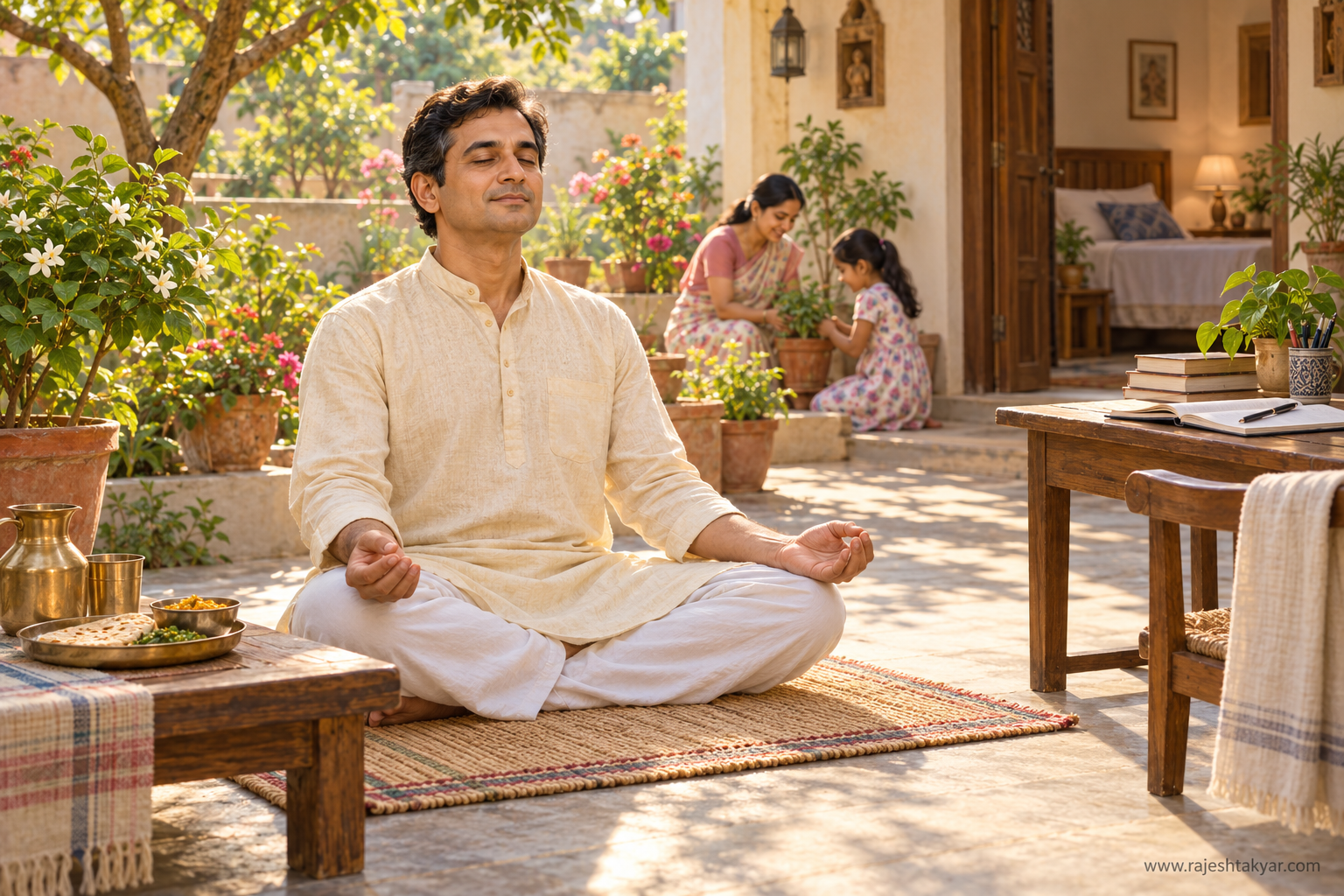
Seeing Practice Across the Whole Day
We make time for spiritual practice, but do we also prepare our lives for it? This question repeatedly brings me back to the dialogue in the Shrimad Bhagavad Gita where Shri Krishna speaks to Arjuna about food, sleep, wakefulness, and action. These matters may seem very ordinary in a discussion about approaching the Divine. Yet our haste to seek inner steadiness while overlooking them deserves attention. We want to change the moment of meditation without examining the daily life that leads us to it.
Shri Krishna places the whole of life before the seeker. How much we take, how much we give up, when we rest, and the spirit in which we work are all questions connected with practice. If the mind is to move in one direction, we must also examine the direction of our activities. Simply sitting down after a day of chasing desires does not automatically end our inner distraction. Continually subjecting the body to hardship does not, by itself, prove spiritual progress either.
नात्यश्नतस्तु योगोऽस्ति न चैकान्तमनश्नतः।
न चातिस्वप्नशीलस्य जाग्रतो नैव चार्जुन॥ १६ ॥
Before this verse, I place the assumption within me that links every achievement with doing more. More food will bring pleasure, more fasting will purify me, more wakefulness will deepen practice: how quickly the mind mistakes quantity for value. Shri Krishna draws us out of this haste. He points towards both ends of excess. Leaving one extreme only to reach the other is not balance. We must make our lives capable of moderation.
Seriousness in spiritual practice cannot mean a display of harshness towards ourselves. If my attention is occupied with calculating how much more I have endured than others, what am I enlarging within? Is my gaze directed towards the Divine or towards my image of myself as a seeker? Moderation does not allow me to evade this question. It asks me to examine my practice, its intention, and its daily consequences together.
I therefore do not confine yoga to a small, separate portion of the day. Sitting down to practise may be necessary, but living in a way that supports it is an equally serious matter. The order that takes shape in life, from waking to fulfilling our responsibilities, prepares the ground for practice. The mind that remembers God is not another mind, separate from our ordinary behaviour. If I scatter it throughout the day, I am also the one demanding that it become steady within a few moments.
Need and Attachment in Eating
In speaking about food, Shri Krishna cautions against two opposing extremes. On one side is the desire to keep taking; on the other is an insistence on giving things up that loses sight of one's limits. The mind's insistence can operate in both. One is drawn by taste; the other becomes bound to the idea of its own renunciation. Moderation is no longer a question about the plate alone. It is also a question about the desire seated before it.
If I treat my need and my wish as the same thing, recognising a limit will be difficult. Alongside the freedom to take what is before me, I need the awareness to stop when there is enough. Here a simple practice of self-discipline becomes visible. Every desire need not be treated as a command. Its arising and my following it are two distinct situations. Only when this space for observing my behaviour remains can discernment enter my choices.
The purpose of renunciation must also be understood. If giving things up becomes an end in itself, the central purpose of practice can fall behind. Shri Krishna's direction is to turn body and mind towards the Divine. Entangling them in a struggle that keeps attention fixed on one's own difficulty complicates that direction. If I keep measuring the severity of my rule and forget its purpose, I can obey the rule while moving away from its meaning.
This does not diminish the value of discipline. It gives discipline understanding. Moderation in eating means receiving according to need, rather than becoming caught in the pull between excessive indulgence and excessive renunciation. Limiting one's wishes and respecting one's needs can go together. The seeker must learn to distinguish between them. Merely reducing an outward quantity cannot fully replace recognising the attachment within.
A small precaution seems useful to me here. Before declaring what I have done superior, I should examine the direction it gives my mind. Have I become more attentive? Is my attention on my purpose? Has my moderation brought humility within, or has it increased my eagerness to judge other people's lives? The value of practice should become visible within me, rather than only in my description of it.
Eating is an ordinary activity, yet our disposition can reveal itself before it. We need not always wait for a great occasion. The difference between need, desire, and moderation presents itself every day. Moving forward while understanding that difference connects spiritual practice with conduct. The more clearly I recognise this connection, the clearer it becomes that spiritual life cannot begin by treating ordinary life as insignificant.
The Place of Rest and Wakefulness
Shri Krishna's indication concerning sleep and wakefulness is equally clear. He does not regard either excessive sleep or continual wakefulness as favourable to practice. Here we need to understand the place of rest. Sometimes we mistake remaining constantly occupied with work or practice for dedication itself. Pausing seems like weakness. Yet practice requires attentiveness; the stubbornness of continually struggling against one's needs cannot itself be called attentiveness.
There is a kind of honesty in accepting rest. I recognise the limits of my body and mind. Accepting them does not mean retreating from my purpose. Caring for the means through which I move towards that purpose is also part of dedication. Continually postponing responsibilities in the name of rest is another matter. The distinction between rest and idleness becomes visible in what follows: do I return to my work, or keep avoiding it?
Being awake cannot mean only having one's eyes open. The question of how waking time is used accompanies it. If time remains available while work is delayed without reason, staying awake longer does not bring discipline. The outlook of spiritual practice goes beyond filling time. It seeks sincerity, order, and discernment in its use. Connecting wakefulness with purpose is a more serious task than taking pride in its duration.
I see no competition in this teaching over who can become a greater seeker by sleeping less or staying awake longer. Comparison turns the gaze of practice outward again. I must recognise an order in my own life that keeps me honest towards both responsibility and practice. Describing a strict rule to others is easy; recognising the desire behind it in solitude can be harder. Inner truthfulness is therefore necessary in moderation too.
The order of daily life repeatedly brings us to the same basic question: for what am I doing all this? If the aim is inner steadiness, increasing unnecessary disorder in my life while expecting that steadiness creates a contradiction. Appropriate rest, attentive wakefulness, and regular practice need not be seen as opponents. They are parts of one life. Spiritual practice also means recognising the relationship between them and remaining attentive to it.
Bringing Action and Inner Remembrance Together
Shri Krishna goes on to connect our efforts in action with moderation. This indication matters greatly to me because we sometimes erect a wall between spiritual life and ordinary responsibilities. Family work, social obligations, and earning a livelihood seem separate from practice. Then, in seeking inner peace, we begin to resent outward duties. This passage of the Gita asks us to reconsider that division.
Moderation in action means recognising and fulfilling responsibility. Doing work on time, remaining watchful of idleness and excessive effort, and acting with dedication prepare the ground for practice. If I repeatedly postpone a task and then become anxious about completing everything at once, I too have contributed to my disorder. It is necessary to see this. Blaming circumstances alone cannot free me from examining my choices.
Similarly, remaining immersed in work alone does not automatically fulfil inner practice. Life has both an outward and an inward side. Attending to one while forgetting the other leaves something incomplete. We must consider both forgetting family responsibilities while remaining absorbed in devotion and devoting all our awareness to worldly work while forgetting remembrance of God. Acting outwardly while remembering God within points towards this balance.
The spirit of dedication does not make me careless in my work. It asks for sincerity. Fulfilling a responsibility I have accepted is also a test of my conduct. If I place my burden on others in the name of practice, I am measuring the balance of life solely by my own convenience. Living with family and society joins responsibility towards others to my own needs. Here the meeting of spirituality and conduct becomes visible.
I should look at my daily routine and ask what always receives space and what is always postponed. If time is continually found for desire while necessary work and self-reflection are left behind, recognising this is the first honest step. Balance is not confined to doing a little less of one activity. It is the understanding that gives necessary things their proper place in the direction of life.
Making Balance a Living Practice
युक्ताहारविहारस्य युक्तचेष्टस्य कर्मसु।
युक्तस्वप्नावबोधस्य योगो भवति दुःखहा॥ १७ ॥
In this verse, food, daily activity, action, sleep, and wakefulness appear together. We cannot attend to one habit and close our eyes to the rest of life. If seriousness during meditation continues alongside carelessness in ordinary conduct, practice will raise questions within. To regard yoga as a way of life is to accept these questions. I examine more than the time I give to practice; I also examine the direction of my mind outside it.
Here the meaning of freedom from suffering unfolds in relation to inner restlessness, pain arising from desires, and bondage. The aim of practice is not simply to make the day convenient. It must turn towards the relationship between the soul and the Divine. Moderation gives that journey a foundation in daily conduct. In a life that changes direction with every desire, the longing for steadiness will have to face one's own behaviour.
Our outlook towards joy and sorrow also enters this practice. When joy arrives, may I not become so absorbed in it that I abandon discernment; when difficulty arrives, may I not take it to be life's final truth. Preserving the direction of action and remembrance of God in both situations is a deeper test of moderation. Outward order joins with inward understanding. Drawing up a list of rules does not complete this work.
I see no need to begin this practice with a grand display. Paying real attention to where there is excess, postponement, or forgetfulness of purpose in our ordinary routine is a sufficient beginning. That understanding must then be sustained in conduct. Only when something recognised today is also visible in my actions tomorrow does thought become practice. The value of moderation unfolds through continually remembering and living it.
Ultimately, balance in practice means taking the whole of one's life towards the Divine. Let food, rest, work, and remembrance be connected by understanding, rather than pulling in different directions. I no longer feel the same haste to seek proof of being a seeker in exceptional severity. I first examine how attentively, responsibly, and moderately I am living my ordinary life. Every day, this question brings spiritual practice back to me.
Reference: Shrimad Bhagavad Gita — Self-Discipline


Comments
Post a Comment